
How To Be Firm With Your Child Without Being Too Strict Nor Too Permissive
Dr M Nithya Poornima
For a parent, it is difficult to strike a balance between being strict and permissive. Read on to know how to achieve that balance, what it means to be a firm parent, and why it is good to be one

Parenting can be like walking a tightrope, the success of which is defined by the balance maintained. Firm parenting is the very essence of that balance, hinging on being authoritative and not authoritarian. Dr. M. Nithya Poornima, our expert from the National Institute of Mental Health and Neurosciences (NIMHANS), Bengaluru, explains why firm parenting holds the key to raising successful children.
All of us would have used rubber bands for some purpose or the other. So, even as you are reading this, it would be a good idea to get one and try stretching and easing it. Wondering why? The simple rubber band is a wonderful analogy of firm parenting - when it is too tight it hurts, and if it is too loose it won't be of any use! Firm parenting helps children learn containment and limits, just as an effective rubber band would.
What does firm parenting mean?
- Being firm is resolutely enforcing clear and reasonable limits and being kind while doing so.
- Being firm is NOT about being harsh.
The science behind firm parenting
Before understanding this, let's look at a series of interesting studies conducted in the 1960s by Dr. Diana Baumrind, a clinical and developmental psychologist in the USA. During her research, Dr. Baumrind observed that parents could be:
- Authoritarian (too tight a rubber band),
- Permissive (too lax a rubber band) and
- Authoritative (tight enough to hold up and equally, lax enough to stretch).
Those parents identified as being authoritative were observed to combine warmth and emotional responsiveness with reasonable control. They had often modeled caring and self-controlled behavior, which, in turn, allowed children to develop emotion-regulation skills and social skills. Subsequent studies on the subject too proved that children raised with firm parenting can internalize effective principles for emotional and behavioral regulation.
The science behind firm parenting is simple. It helps children learn to exercise restraint and understand the extent to which limits can be stretched. It conveys that there are clear, reasonable, and predictable ways to understand how far limits can be stretched and when they will be strictly enforced in a kind and respectful way.
The art of firm parenting
While many parents may be aware of the principles detailed above, they often find it difficult to put the ideas into practice. Well, practice is indeed the keyword! It is important to bear in mind that when it comes to parenting, not all skills blossom effortlessly. Being firm is one skill that shows definite improvement with practice. Also, like any art, parenting too requires the use of basic techniques and then experimenting with improvisations.
The best approach is to acknowledge that parenting involves learning new skills, most often, on the job. While addressing routine trouble spots parents should attempt to identify a variety of responses that can be delivered compassionately and creatively. This is an extremely useful exercise in enhancing a parent's skills, specifically in being firm. Children often seem to train parents to use firmness effectively with their demands and misdemeanors! Like an artist chooses hues and strokes, parents will also need to consciously and intuitively choose when they will be firm and how they will communicate their firmness to their children.
BENEFITS OF FIRM PARENTING
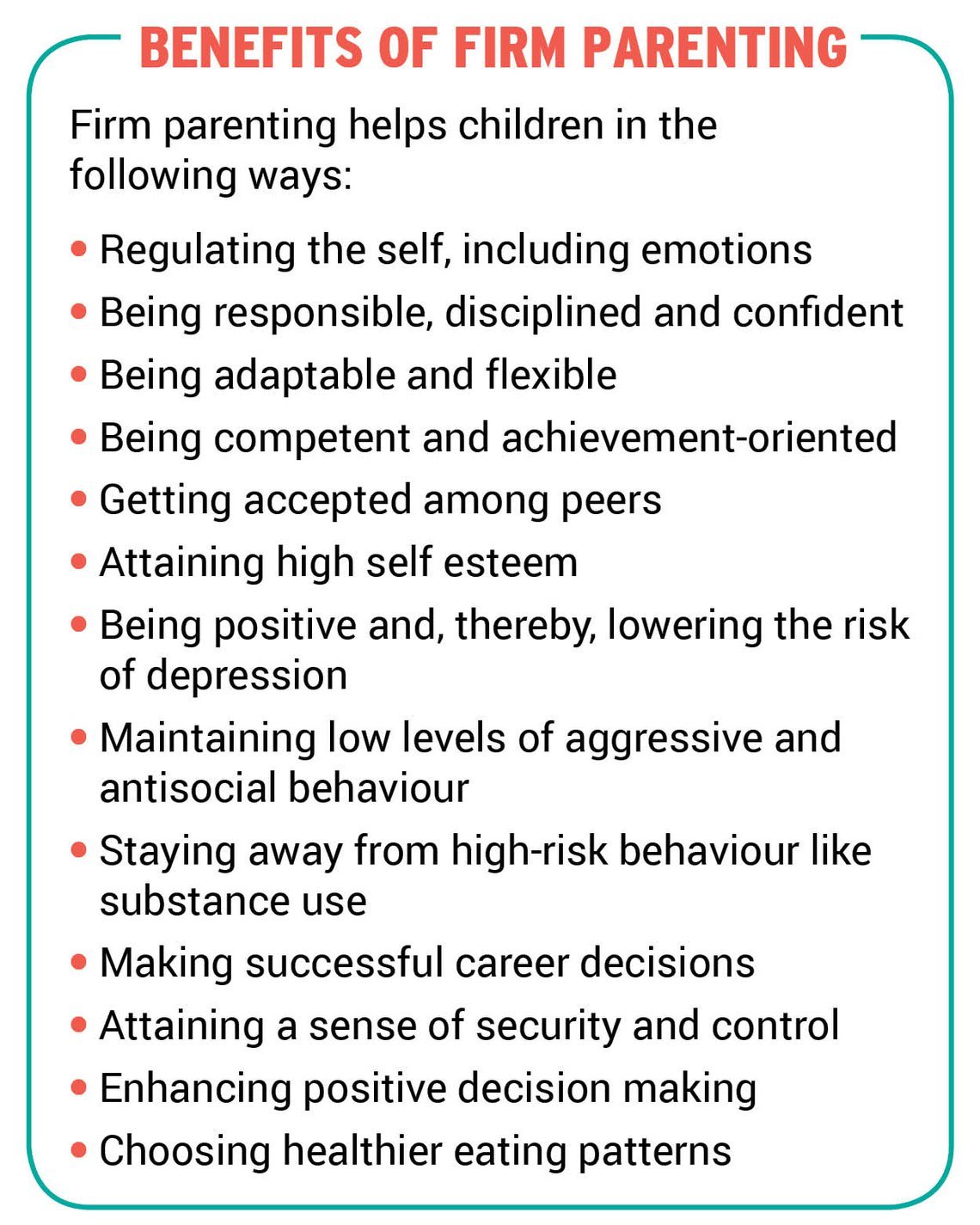
Firm parenting helps children in the following ways:
- Regulating the self, including emotions
- Being responsible, disciplined, and confident
- Being adaptable and flexible
- Being competent and achievement-oriented
- Getting accepted among peers
- Attaining high self-esteem
- Being positive and, thereby, lowering the risk of depression
- Maintaining low levels of aggressive and antisocial behavior
- Staying away from high-risk behavior like substance use
- Making successful career decisions
- Attaining a sense of security and control
- Enhancing positive decision making
- Choosing healthier eating patterns
HOW TO BE A FIRM PARENT
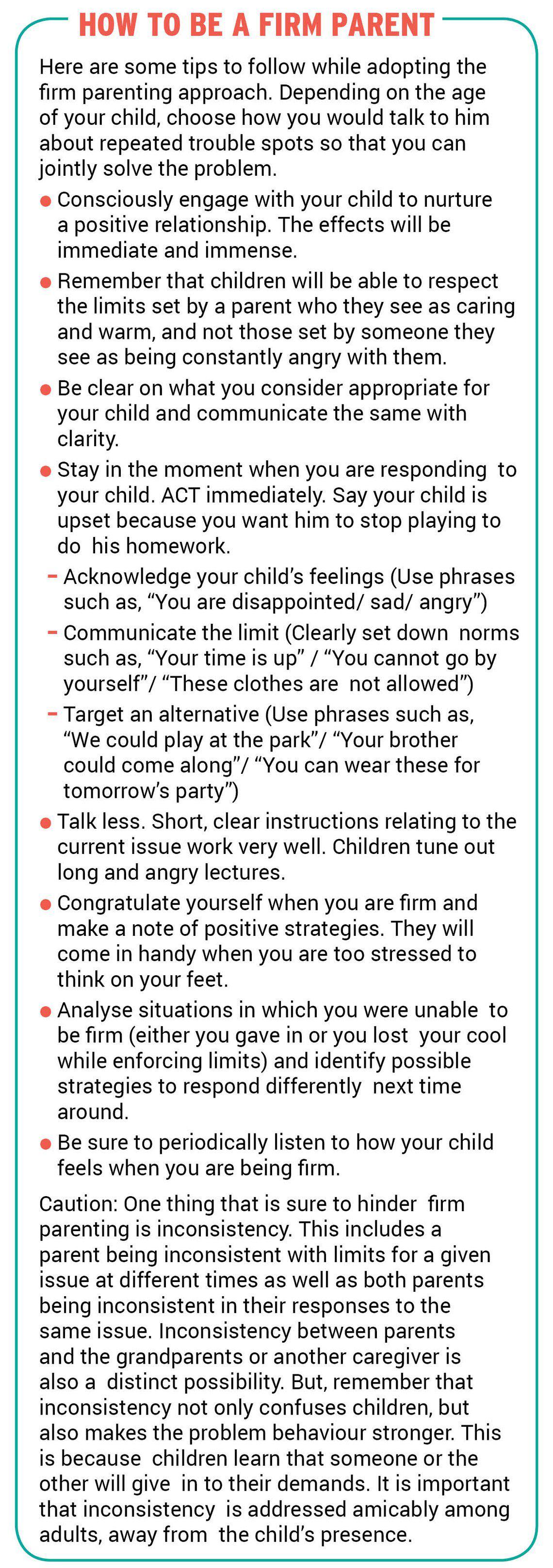
Here are some tips to follow while adopting the firm parenting approach. Depending on the age of your child, choose how you would talk to him about repeated trouble spots so that you can jointly solve the problem.
- Consciously engage with your child to nurture a positive relationship. The effects will be immediate and immense.
- Remember that children will be able to respect the limits set by a parent who they see as caring and warm, and not those set by someone they see as being constantly angry with them.
- Be clear on what you consider appropriate for your child and communicate the same with clarity.
- Stay in the moment when you are responding to your child. ACT immediately. Say your child is upset because you want him to stop playing to do his homework.
- Acknowledge your child's feelings (Use phrases such as, "You are disappointed/ sad/ angry")
- Communicate the limit (Clearly set down norms such as, "Your time is up" / "You cannot go by yourself"/ "These clothes are not allowed")
- Target an alternative (Use phrases such as "We could play at the park"/ "Your brother could come along"/ "You can wear these for tomorrow's party )
- Talk less. Short, clear instructions relating to the current issue work very well. Children tune out long and angry lectures.
- Congratulate yourself when you are firm and make a note of positive strategies. They will come in handy when you are too stressed to think on your feet.
- Analyse situations in which you were unable to be firm (either you gave in or you lost your cool while enforcing limits) and identify possible strategies to respond differently next time around.
- Be sure to periodically listen to how your child feels when you are being firm.
Caution: One thing that is sure to hinder firm parenting is inconsistency. This includes a parent being inconsistent with limits for a given issue at different times as well as both parents being inconsistent in their responses to the same issue. Inconsistency between parents and the grandparents or another caregiver is also a distinct possibility. But, remember that inconsistency not only confuses children but also makes the problem behavior stronger. This is because children learn that someone or the other will give in to their demands. It is important that inconsistency is addressed amicably among adults, away from the child's presence.
An example of firm parenting
Scenario: 11-year-old Pawan wants to watch his favorite programs on television for most of the day. Attempts to turn off the television set or even change the channel guarantees a 10-minute argument or severe tantrums lasting over an hour. He often wants to skip school so that he can watch his favorite shows. Sometimes his parents give in, but at other times, they expect him to stop watching the television immediately.
His parents try various strategies to wean him away they distract him, cajole, request, instruct, threaten, and sometimes, even yell at him or spank him. Besides making them feel helpless, angry, and miserable, Pawan's parents have realized these strategies haven't been successful. This situation is like a very lax rubber band.
Firm parenting in this situation would serve the purpose of establishing clear limits regarding television time. Both parents need to consistently enforce these limits at multiple points in time. Use the ACT principle here.
Parents can say:
Step 1: "Pawan, your TV time is till 5 pm; you have ten minutes more!"
Step 2: "Now, the time is up!"
Step 3: "Let's go and have a snack / go out to play."
If you haven't picked up that metaphorical rubber band yet, now's the time to look for one. So, choose one and test its strength and thereby, learn how to bring balance into your parenting. Why, doing so could even help you figure out how to implement firm parenting, with regard to your own child!




























Comments
Rajesh R May 4, 2021
-

1Edit
Comment Flag
Cancel Update