
Logical Thinking In Children: Simple Everyday Ways To Build Reasoning Skills In Preschoolers
Sidhika Goenka
Learn how logical thinking develops in preschoolers and discover simple questions, games, and everyday activities to build reasoning skills

"A little mouse wants to eat the mangoes on the tree. Do you think he can climb the tree and eat the mangoes?" I ask my 3-year-old.
She thinks and says, "The mouse could get a ladder to climb the tree and eat the mangoes."
"The ladder may be too heavy for the mouse."
Then she thinks again and excitedly says, "The mouse calls his friend, a huge elephant, and climbs on the elephant's back and eats the yummy mangoes."
How did she come up with that?
The answer is simple: my child was using her thinking and problem-solving skills to find a solution.
"Logic is built on observation." The more you ask children questions such as "How will that happen?", the more opportunities you give them to think things through." - Sanjay Raghav, chief of operations, Centre for Teaching and Learning Mathematics.
What is logical thinking?
Logical thinking is the ability to make connections, notice patterns and sequences, and use what we know to reach a conclusion or solve a problem. Children develop these abilities gradually as they explore, observe, and make sense of the world around them.
Children may not always be able to explain how they arrived at a conclusion, but their actions often show that they are making connections. You can see logical thinking in their routine actions.
For example, when their hands get dirty, they want to wash them; they put on socks before putting on shoes; they peel the crayon wrapper when the crayon finishes. These are simple ways children begin to understand relationships, sequences, and what happens next.
Logical thinking is closely related to problem-solving and critical thinking. All three involve making connections, thinking of possibilities, and working things out.
Why is logical thinking important for children?
When children play on their own, they often face challenges they have to overcome. Challenges give them opportunities to think, try different approaches, and learn from what happens.
For example, my 2.4-year-old loves playing with balls. I have given him balls of different sizes, which he has to put through a hoop. He maneuvers different balls through the ring to see which one fits, and he figures out that small balls go through the ring and big balls will not. When my child gets frustrated if the big ball doesn’t fit, I don’t rush to help him. Instead, I patiently wait for him to figure it out.
Toddlers solve problems through trial and error. During play, children discover real-life skills that help them identify problems, explore possible solutions and apply them.
Logical thinking also supports learning. Activities involving patterns, sequencing, sorting and comparing help children see relationships and organise information. These are useful skills as children learn early maths, language and other concepts.
Don't rush to give your child the answer
One of the simplest ways to encourage logical thinking is to give your child time to think.
When your child faces a small problem, you may be tempted to step in and show them what to do. Instead, pause and let your child try. You can guide their thinking with simple questions:
- "What do you think will happen?"
- "Why do you think that?"
- "What else could you try?"
- "Which one will fit?"
- "What comes next?"
- "How could we solve this?"
"Concrete examples, language, and questioning are important. Asking questions encourages your child to analyse and evaluate, thereby stretching their thinking." - Sanjay Raghav.
The aim is not to test your child or turn every activity into a lesson. Let your child explore, make mistakes and try again. Sometimes, the process of figuring something out is more valuable than getting the right answer immediately.
Simple activities to build logical thinking
You don't need special toys or worksheets to encourage logical thinking. Everyday objects, toys and play can provide plenty of opportunities.
1. Try patterns and sequences
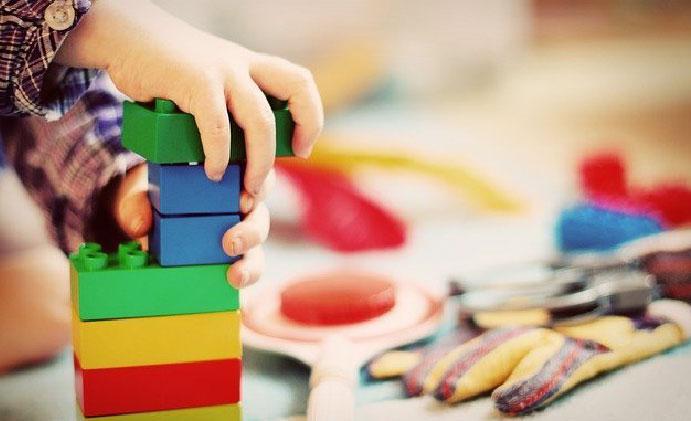
Give your child blocks, beads or toys of different shapes, colours and sizes, and ask them to identify and arrange them in patterns.
For instance, create a simple colour pattern: red block, blue block, red block, blue block, and ask your child what comes next.
You can also use picture cards to create a simple sequence. Ask, "What happens first?" or "What do you think will happen next?"
2. Sort and group objects
Sorting helps children notice similarities and differences and think about how objects are related.
Give your child toys or household objects of different shapes, sizes and colours, and ask them to sort them. For example, all the yellow blocks together, or all the toy cars in one pile and animal toys in another.
You can also let your child decide how to sort the objects without giving directions. Ask, "How did you decide to put these together?" or "Why do these belong in the same group?"
A shape sorter is another simple way to practise this skill. If your child tries to push a triangle into a rectangular space, ask, "Why do you think it is not fitting?"
3. Line up toys
Give your child four or five toys and let them arrange them in ascending or descending order of size. This encourages them to think about order and attributes such as size.
You can also ask your child to arrange toys according to clues. Instead of saying, "Put the car first," give a clue such as, "Put the toy with wheels first in line." Or say, "The animal with spots is last in line."
4. Encourage pretend play
Pretend play gives your child opportunities to make logical connections and think through different possibilities.
Set up a pretend-play box with old clothes. Could your child use Dad’s old shirt to make a doctor’s coat? Can they wear a hat and turn into a magician? Let them mix and match the clothes in different ways.
You can also provide open-ended materials and props, such as toy dishes, blocks or cushions, and let your child develop their own ideas for play.
5. Turn everyday problems into thinking opportunities
Look for small problems your child can solve during everyday activities.
While getting dressed, ask, "What comes first, socks or shoes?" While putting away toys, ask, "Which toys belong together?" While cooking, you could ask, "We need two cups. How many do we have?"
You can also create simple challenges. Put a few large and small objects together and ask, "Which one will fit here?" Or create a simple treasure hunt with paper Xs leading to a small snack or sticker.
The aim is not to make things difficult. Give your child a chance to observe, think and try.
Look for opportunities to ask, "What do you think?"
Logical thinking develops through everyday experiences. You can encourage it while your child is playing, getting dressed, helping around the house, or listening to a story.
Instead of immediately giving them an answer, try asking, "What do you think?" "How do you know?" or "What could we try?"
When children are given the time and space to think, they learn that problems can have more than one possible solution. They also begin to understand that mistakes are steps towards finding better solutions.
What parents can do
- Give your child time to work things out before stepping in.
- Ask, “What do you think?” and “What could you try?” instead of giving immediate answers.
- Use everyday activities such as sorting, patterns, sequencing and pretend play to encourage thinking.
- Let your child try, make mistakes and try again.
- Praise curiosity, effort and different ways of solving a problem.
Your child does not need complicated puzzles or special learning tools to develop logical thinking. Everyday play, conversations and simple challenges offer plenty of opportunities to observe, make connections and solve problems. So, the next time your child faces a small challenge, pause before stepping in. Ask a question, give them time to think, and let them discover the answer. These small moments can help your child become a more confident and independent thinker.
Sidhika Goenka is a strength-focused psychologist, parenting expert, happiness coach, educator, and professional storyteller. She works closely with children and families, helping them build confidence, emotional wellbeing, and positive parent-child relationships through play-based learning and practical parenting strategies.
Need more information? Trusted resources:
- National Curriculum Framework for Foundational Stage (NCF-FS), NCERT, 2022
- Center on the Developing Child, Harvard University–A Guide to Executive Function
- Center on the Developing Child, Harvard University– Activities Guide: Enhancing and Practicing Executive Function Skills
Last updated on: August 11, 2026






















Comments
Edit
Comment Flag
Cancel Update